BMX Part
Pegs
Pegs are cylindrical metal or plastic tubes bolted to the axle of a BMX wheel so a rider can stand on them or grind along ledges and rails.
Updated 3 min read630 words
Pegs are short cylinders that bolt onto the wheel axles of a BMX bike. Riders stand on them and, more often, use them to grind along ledges, rails and coping. They are a core part of street riding and appear in park and flatland too.
What it does
A peg gives the rider a hard, rounded surface to grind on. It sits outside the frame and the fork, so it can touch an obstacle while the tyres and frame stay clear. The peg also lets a rider stand on the axle, as in a stall.
Some tricks that use pegs include the feeble grind, the double peg grind and the smith grind.
Types and standards
Materials
| Material | How it grinds | Notes |
|---|---|---|
| Steel (chromoly or mild) | Sticks on concrete, can be loud and bite on metal | Strong and long lasting. Heavier. |
| Aluminium | Slides on metal, wears faster on concrete | Light. Can deform on hard hits. |
| Plastic sleeve on a core | Slides smoothly on most surfaces | The plastic wears and is replaceable. |
| Solid plastic | Slides smoothly and cheaply | Light, but may crack under heavy hits. |
The shift to plastic
Over the last decade or so, many street riders have moved from bare steel to plastic or plastic-sleeved pegs. The main reasons are speed and kindness to the spot. Plastic slides on concrete without the catch and noise of steel, and it does less damage to ledges. It also wears away instead of locking up, so riders can use the same pegs on rails and concrete. Steel still has fans, especially for riders who grind hard or want a long-lasting peg.
Length
Two lengths are common: about 4 inch and about 4.5 inch. A longer peg gives more landing and grinding area and can feel more stable. A shorter peg is lighter and sits closer to the frame.
Axle fit
| Bore | Matching axle |
|---|---|
| 14 mm | 14 mm axle (the usual modern size) |
| 10 mm | 10 mm (3/8 inch) axle |
Some pegs come with sleeves or adaptors to fit both sizes.
How many pegs
- Two pegs. Rear axle only. Lighter and enough for many grinds.
- Four pegs. Front and rear. Allows front-peg tricks. Heavier.
- No pegs. A bike with no pegs is called pegless.
Sizing and compatibility
- Match the peg bore to your axle size: 14 mm or 10 mm.
- Make sure the axle has enough thread to hold a nut and the peg. Axles may need longer bolts.
- Check clearance between the peg and the frame, tyre and brake.
- Front pegs need a fork and hub that can take them.
How to choose
- Decide how much street riding you do. If you grind ledges and rails, pegs are worth it.
- Choose material by surface. Plastic suits concrete and mixed spots. Steel suits riders who want durability.
- Pick length: 4.5 inch is common, 4 inch for a tighter feel.
- Check axle size. Buy pegs that fit your bike without adaptors if you can.
- Start with two pegs if you are new to grinds.
Basic pegs cost little, and sleeve or high-end sets cost more. Plastic sleeves are cheap to replace.
Maintenance
- Check the axle nuts often. Loose pegs can spin or slip off.
- Replace worn plastic sleeves before the core is exposed.
- Look for cracks in aluminium or steel pegs.
- Wax or lube plastic sleeves lightly if they stick. A little wax helps them slide.
- Remove the pegs when you do not need them. This also stops them catching on things.
- Check that pegs do not rub against the rim or the frame.
Related parts
- Frame geometry: peg clearance depends on frame and fork.
- Rims: pegs must clear the rim and tyre.
- Pegless: the setup with no pegs.
- Street: where pegs are most used.
- Hub guards: protect the hub and axle ends from grinds.
Frequently asked questions about Pegs
Should I run two pegs or four?
Two rear pegs are enough for most grinds and keep the bike lighter. Four pegs let you grind on the front as well, which suits riders who do front-peg tricks. Many riders start with two.
Do I need 14 mm or 10 mm pegs?
It depends on your axle. Most modern bikes use 14 mm axles, but some use 10 mm. A peg bore must match the axle, or you need an adaptor. Check your hub first.
Are plastic pegs better than steel?
They are not strictly better, but many street riders prefer them. Plastic slides smoothly on concrete and metal, wears away instead of chewing up ledges and is quieter. Steel lasts longer and is cheaper per grind but can catch.
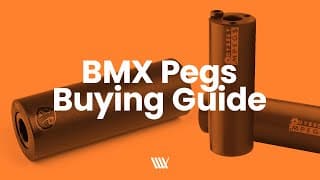
Watch on the LUXBMX YouTube
A video about Pegs from the LUXBMX YouTube channel.
Shop at LUXBMX
Popular picks for this article from LUXBMX, an Australian BMX store.
 Odyssey MPEG Pegs PairView the Odyssey MPEG Pegs Pair at LUXBMX
 Cult Butter Peg (Each)View the Cult Butter Peg (Each) at LUXBMX
 Salt AM Nylon Pegs (Pair)View the Salt AM Nylon Pegs (Pair) at LUXBMX
Photos: LUXBMX
BMX Wiki and LUXBMX share an owner. Links to the store are not paid placements and do not change what articles say. About this relationship
Related articles
Pegless
Pegless means riding a BMX bike with no pegs fitted, a common setup in dirt, park and some street riding that favours air tricks over grinds.
2 min readFeeble grind
A feeble grind is a BMX grind where the rider slides the rear peg along a ledge or rail while the front wheel rolls along the top of the obstacle.
3 min readDouble peg grind
A double peg grind is a BMX grind where the rider slides both the front and rear pegs along the same side of a ledge, rail or coping.
4 min readSmith grind
A smith grind is a BMX grind where the rider slides the front peg along a ledge or rail while the rear wheel rolls along the top of the obstacle.
3 min readStreet
Street BMX is the discipline of riding urban architecture such as ledges, rails, stairs and banks, with video parts rather than contests as the main measure.
5 min readRims
A rim is the circular aluminium hoop of a BMX wheel that holds the tyre and is laced to the hub by spokes, taking the impact of landings and grinds.
3 min read