BMX Part
Seat and Seatpost
A BMX seat and seatpost form the small saddle assembly that clamps into the frame's seat tube, and many street riders run it slammed low or removed.
Updated 3 min read651 words
A BMX seat and seatpost together make up the saddle assembly. The post slides into the frame's seat tube and clamps there, and the seat sits on top. On freestyle bikes the seat is small, and street riders often run it very low.
What it does
The seat gives a place to sit during climbs, sprints or rest. It also affects pedalling height and body position. On a trick bike it often does little work, so the aim is to keep it out of the way.
Types and standards
| Type | Description | Typical use |
|---|---|---|
| Pivotal | The seat tab locks into a post head with a bolt that sets the tilt | The most common freestyle setup. Compact and strong. |
| Tripod | The seat mounts to the post on three points | Similar use to pivotal. Strong and neat. |
| Combo | The seat and post form one moulded unit | Light, simple and cheap. Height fixed or limited. |
| Railed | A conventional seat on metal rails, clamped to the post | Adjustable fore and aft. Common on race and older bikes. |
Seat heights
- Slammed (or low). The seat sits right down on the seat tube or the post is cut short. Common in street and park.
- Mid. A little height for a mix of pedalling and tricks.
- Full height. Common on race bikes and for longer rides.
Seatpost
The standard BMX post diameter is 25.4 mm (1 inch). It must match the inside of the seat tube. Posts are often cut to the desired length. Most are steel or aluminium. A seat clamp on the outside of the frame tube locks the post in place.
Sizing and compatibility
- Post diameter. Check the frame's seat tube inside diameter: 25.4 mm is standard.
- Seat clamp. Match the clamp to the frame's seat tube outside diameter. Many bikes include a clamp with the frame.
- Seat mount type. The post and seat must match. A pivotal seat needs a pivotal post. A railed seat needs a post with a rail clamp.
- Height. Set the seat so you can pedal comfortably if you need to. Most trick riders accept a low height.
- Seat tube angle and length. These are part of frame geometry. They affect how the seat sits relative to the cranks.
How to choose
- Decide how much you pedal. Race and dirt riders pedal more, and need more height. Street riders pedal less.
- Pick the seat type: pivotal or tripod for simplicity, railed if you want fore and aft adjustment.
- Check the post diameter against your frame.
- Think about weight. Combo seats are light, but they cannot be adjusted much.
- Look at the finish. A good seat resists tears and damage.
Basic seats cost little, and stronger or lighter versions cost somewhat more. Check the build rather than the label.
Why street riders slam the seat
On street spots the seat can catch on ledges, rails and the rider's own legs. Slamming it avoids snags and lets the rider move freely. Some riders choose to remove the seat entirely. Others keep it for rest or for a casual ride between spots. Race bikes need the opposite: a higher seat to allow full pedal power.
Maintenance
- Bolt check. Tighten the seat clamp and pivot bolts regularly. A loose seat can shift mid-trick.
- Grease. Put a little grease on the post before inserting it. This stops it seizing in the frame, especially on steel frames.
- Inspect the post. Look for cracks at the clamp area and at the base of the seat mount.
- Seat cover. If the cover tears, water gets in the foam. Replace the seat when it starts to fall apart.
- Cut posts carefully. Mark the length twice, cut square and deburr the end.
Related parts
- Frame geometry: seat tube length and angle.
- Pedals: seat height changes pedalling reach.
- Street: where slammed seats are most common.
- Racing: where full height seats are standard.
- How to set up a new BMX: includes seat position.
Frequently asked questions about Seat and Seatpost
Why do street riders run their seat so low?
A low seat stays out of the way for tricks. Riders do not want it catching their legs on a bunny hop, a tailwhip or a ledge ride. Some riders remove it completely, though it still gives a place to sit when needed.
What size is a BMX seatpost?
25.4 mm (1 inch) is the common BMX standard. It must match the frame's seat tube inside diameter, so check the frame before buying.
What is the difference between a pivotal and a tripod seat?
A pivotal seat has a tab that sits in the post head and is held by one bolt, so you set the tilt by loosening it. A tripod seat uses a three-leg mount instead. Both are compact and secure.
Watch on the LUXBMX YouTube
A video about Seat and Seatpost from the LUXBMX YouTube channel.

Shop at LUXBMX
Popular picks for this article from LUXBMX, an Australian BMX store.
 Odyssey Aitken Pivotal SeatView the Odyssey Aitken Pivotal Seat at LUXBMX
 Odyssey Aitken Railed SeatView the Odyssey Aitken Railed Seat at LUXBMX
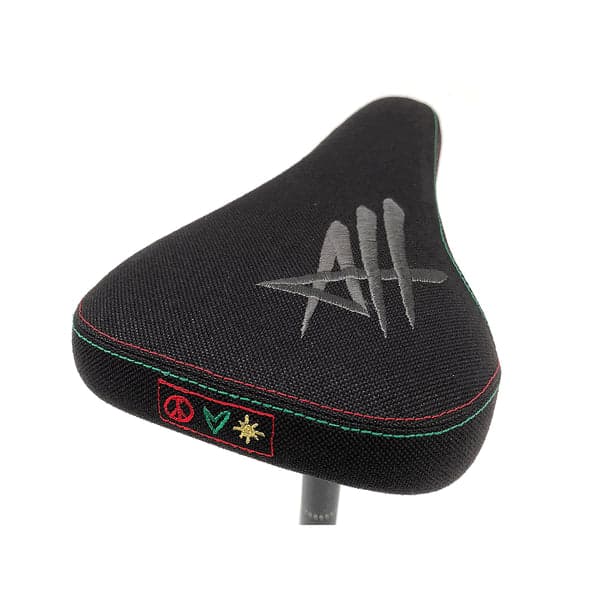 Colony Alex Hiam Seat ComboView the Colony Alex Hiam Seat Combo at LUXBMX
Photos: LUXBMX
BMX Wiki and LUXBMX share an owner. Links to the store are not paid placements and do not change what articles say. About this relationship
Related articles
Frame Geometry
Frame geometry is the set of measurements, such as top tube length, head tube angle and chainstay length, that decides how a BMX frame fits and rides.
4 min readPedals
BMX pedals are the platforms that thread into the crank arms and give the rider's feet a grippy surface to push, jump and balance on.
3 min readStreet
Street BMX is the discipline of riding urban architecture such as ledges, rails, stairs and banks, with video parts rather than contests as the main measure.
5 min readRacing
BMX racing is a sprint for up to eight riders on a dirt track with a start gate, jumps and berms, governed by the UCI and an Olympic sport since 2008.
5 min readHow to Set Up a New BMX
Unbox your complete BMX, align the bars, fit the pedals on the correct sides, set the brake and seat, and torque every bolt before the first ride.
4 min readBMX Bike Anatomy
A BMX bike is a single speed, 20 inch bike built from about 20 named parts: here is each one in order from the front wheel to the rear wheel.
3 min read