BMX Part
Brakes
BMX brakes are the lever, cable and brake unit that slow the bike, with the rear U-brake being the standard on freestyle bikes.
Updated 3 min read648 words
BMX brakes slow the bike by pressing rubber pads against the rim. On freestyle bikes the standard is a rear U-brake worked by a hand lever. Many riders also choose to ride without any brake at all, which is called brakeless.
What it does
A brake lets a rider slow down or stop at speed and control a roll-in. Pulling the lever draws a cable, which squeezes the brake arms together. The pads grip the sidewall of the rim and create friction.
Freestyle riders use the rear brake to scrub speed, control a drop-in or stop at a spot. Others skip it because it adds weight and a cable.
Types and standards
U-brake and 990 mounts
A U-brake sits under the seat stays near the rear tyre. It has two arms shaped like a U, pivoting on two bosses on the frame. These bosses are called 990 mounts. Most freestyle frames have 990 mounts built in, so any U-brake with the correct pivot spacing will bolt on.
V-brake
A V-brake is a linear-pull design with long arms that rise from bosses on the frame or fork. It has more stopping power and is common on racing bikes. Freestyle bikes rarely use V-brakes since the arms stick out and the cable is long.
| Type | Mount | Typical use |
|---|---|---|
| U-brake | 990 mounts on seat stays | Freestyle: street, park, dirt |
| V-brake | Frame bosses on the stays or fork | Race |
Parts of a brake system
- Lever. Mounted on the bar. Choose a short, two- or four-finger lever with an adjustment barrel.
- Cable. An inner steel cable runs inside a sheath called the housing.
- Straddle cable and hanger. A short cable joins the two arms. The main cable pulls on the straddle through a hanger.
- Pads. Rubber blocks that press on the rim.
- Rim. The braking surface. See rims.
Why most freestyle bikes brake the rear only
- A front brake can lock the wheel and send the rider over the bars.
- Front cables get in the way of barspins and other bar tricks.
- A rear brake gives enough control for most riding.
If you plan to spin your bars, you may also need a gyro detangler to keep the cable from wrapping. See also brakes or brakeless for help deciding.
Sizing and compatibility
- The frame must have 990 mounts for a U-brake.
- Choose pads that fit the brake. Pad shoes come in different lengths and thread styles.
- Cable length depends on the bar and frame size. Cut housing to the right length, with no kinks.
- Aluminium rims suit rubber pads best. Steel or worn rims reduce braking.
- If you run a gyro detangler, the lever cable and brake cable need to match the gyro design.
How to choose
- Decide if you want a brake at all. Beginners and road riders often do.
- For a freestyle bike, choose a rear U-brake that fits the 990 mounts.
- Pick a lever with a comfortable reach and a smooth feel.
- Choose pads for grip and wear. Softer pads bite more but wear faster.
- Plan how the cable will run, and decide if you need a gyro.
U-brake kits range from budget to premium. Higher prices usually mean better pads, smoother levers and stiffer arms.
Maintenance
- Pads. Check wear lines. Replace pads before the rubber is gone. Toe the pad in slightly so the front edge contacts first.
- Rim. Keep the braking surface clean and free of oil.
- Cable. Lubricate the inner cable and replace frayed cables.
- Centring. Adjust the brake so both pads sit evenly from the rim.
- Quick-release or barrel adjuster. Use it to take up slack as the pads wear.
- Lever. Check the pivot bolt is tight and the lever springs back crisply.
Related parts
- Gyro detangler: keeps the cable from wrapping when the bars spin.
- Rims: the braking surface.
- Handlebars: the lever mounts here.
- Brakeless: riding without a brake.
- Brakes or brakeless: how to choose.
Frequently asked questions about Brakes
Do I need a brake on a freestyle BMX?
Not strictly. Many street and park riders go brakeless. A rear brake is useful for beginners, for riding on roads and for steep spots. Check local rules where you ride.
What is a 990 mount?
It is the standard pair of brake bosses on the frame that a rear U-brake bolts to. Most freestyle frames have them, so a U-brake fits without fuss.
Why only a rear brake?
A front brake can lock the wheel and pitch you over the bars. It also adds cable that gets in the way of bar spins. A rear brake is safer and simpler for freestyle.
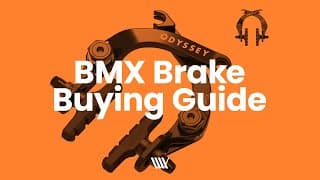
Watch on the LUXBMX YouTube
A video about Brakes from the LUXBMX YouTube channel.
Shop at LUXBMX
Popular picks for this article from LUXBMX, an Australian BMX store.
 Odyssey 1999 Sidepull Brake SetView the Odyssey 1999 Sidepull Brake Set at LUXBMX
 Odyssey Monolever Medium LeverView the Odyssey Monolever Medium Lever at LUXBMX
 Box Three V-Brake KitView the Box Three V-Brake Kit at LUXBMX
Photos: LUXBMX
BMX Wiki and LUXBMX share an owner. Links to the store are not paid placements and do not change what articles say. About this relationship
Related articles
Gyro Detangler
A gyro detangler is a rotating cable device at the headset that lets BMX handlebars spin freely without wrapping the rear brake cable around the frame.
3 min readBrakeless
Brakeless means riding a BMX bike with no brakes fitted, a common setup in street and park riding that frees the bars to spin without cables.
2 min readBrakes or Brakeless on a BMX
Keep a brake while you learn, and go brakeless only once you can stop reliably with your feet, since the choice trades safety for simplicity and freedom.
3 min readRims
A rim is the circular aluminium hoop of a BMX wheel that holds the tyre and is laced to the hub by spokes, taking the impact of landings and grinds.
3 min readHandlebars
BMX handlebars are the tall, swept chromoly bars that steer the bike and take the rider's weight, defined by their rise, width, sweep and clamp diameter.
4 min read180
A 180 is a BMX trick where the rider rotates the bike and body half a turn in the air, usually landing fakie or rolling out via a half-cab.
3 min read