BMX Part
Handlebars
BMX handlebars are the tall, swept chromoly bars that steer the bike and take the rider's weight, defined by their rise, width, sweep and clamp diameter.
Updated 4 min read796 words
BMX handlebars, or bars, are the tall, swept tubes that let a rider steer, lift the front wheel and push the bike through the air. They are built from chromoly steel, they clamp into the stem, and they carry a pair of grips on the ends.
What it does
Bars give leverage over the front wheel. They also take the shock of landings and the force of a pull on the front end. Their shape decides how the bike feels in your hands. A taller bar puts your hands higher and your body more upright. A wider bar gives more control but can snag on rails and walls.
The main measurements
- Rise. The height of the bar from the clamp to the grip. About 8 to 10 inch is common. Taller bars suit taller riders and riders who like a high front end.
- Width. Measured end to end. About 28 to 30 inch is usual. Narrow bars (around 27 to 28 inch) feel tight and quick. Wider bars (around 29 to 30 inch) feel steadier.
- Backsweep. The angle the grips bend back towards the rider. Around 9 to 12 degrees is common. It suits the natural angle of the wrists.
- Upsweep. The angle the grips tilt upward. Often 0 to 3 degrees. A touch of upsweep can relieve wrist pressure.
- Crossbar. The bar between the uprights adds strength and gives a place to attach cables or a pad.
Types and standards
Tube count: 2-piece and 4-piece
- 2-piece bars are made from two bent tubes, one per side, joined by a crossbar. They are simpler, lighter on cost and strong for general use.
- 3-piece bars use a one-piece centre section and two side tubes.
- 4-piece bars build each side from two separate sections, plus a crossbar. This lets the maker use thicker walls where stress is highest and thinner walls elsewhere. Makers often pitch 4-piece bars as stronger for the same weight, but a well-built 2-piece bar is also very durable.
Clamp size
| Clamp | Typical use |
|---|---|
| 22.2 mm (7/8 inch) | Standard BMX bars. Works with most stems. |
| 25.4 mm (1 inch) oversized | Used on some bars for extra stiffness. Needs a matching oversize stem. |
Grip ends are almost always 22.2 mm, so grips fit either bar type.
Materials and tubing
Most bars use chromoly (4130 chromium-molybdenum steel). It is strong, bends instead of snapping and is cheaper than titanium. Aluminium bars exist, usually for race or budget builds. Some makers use butted tubing. Butted tubes are thicker at the ends and thinner in the middle, which saves weight while keeping the strong points strong.
Sizing and compatibility
- Match the clamp diameter to the stem. A bar that does not match will not fit securely.
- Width and rise should suit your height and arm length. A rough start: under 165 cm, 8 inch rise and 28 inch width. Over 180 cm, 9 to 10 inch rise and 29 to 30 inch width.
- Check the crossbar position if you plan to run a gyro detangler or a front brake lever. Some bars have cable routing that works better with certain setups.
- Bar roll, which is the rotation of the bar in the stem, changes the feel. Roll the bar forward and the grips sit lower. Roll it back and they sit higher. Most riders set roll so the grips point slightly up and the wrist stays straight.
How to choose
- Pick rise first. It changes the riding position most.
- Choose width for comfort and control. If you ride a lot of ledges and rails, narrower can help.
- Match sweep to your wrists. If you feel pain after a long session, try a different backsweep.
- Decide on the tube count. A 2-piece bar is enough for most. A 4-piece bar suits riders who want the lightest strong option.
- Check the clamp size against your stem.
Budget bars exist from a low price and go up as materials and construction improve. Higher cost often means better heat treatment, tubing and finish.
Maintenance
- Check the bar for dents, cracks and bends, especially near the stem clamp and welds. A bent bar is a weak bar.
- Tighten the stem bolts evenly, in a cross pattern, to the torque the stem lists.
- If the bar slips in the stem, clean both surfaces and retighten. Do not add grease to the clamp area unless the maker says so.
- Replace bars after hard crashes. Chromoly can crack where it has been stressed, even when the bend is hard to see.
Related parts
- Stem: holds the bars to the fork.
- Grips: fit over the bar ends.
- Forks: the bars connect to the fork through the stem.
- Gyro detangler: lets the bars spin without tangling the brake cable.
- Barspin: the trick that depends on the bars moving freely.
Frequently asked questions about Handlebars
What rise should I choose?
Most adult riders pick between 8 and 9 inch. Taller riders and riders who like a higher front end go to 9.5 or 10 inch. If you are unsure, start at 8.5 and adjust the stem and bar roll.
Do I need a 2-piece or a 4-piece bar?
Both are strong when made from chromoly. A 4-piece bar usually has more tuned tube thickness and costs more. For most riders a good 2-piece bar is fine.
Will a 25.4 mm bar fit my stem?
Only if the stem clamp is also 25.4 mm. A 22.2 mm stem will not take an oversized bar. Check the stem before buying.
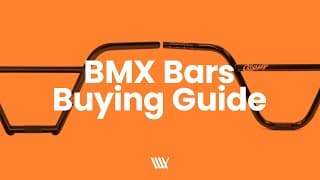
Watch on the LUXBMX YouTube
A video about Handlebars from the LUXBMX YouTube channel.
Shop at LUXBMX
Popular picks for this article from LUXBMX, an Australian BMX store.
 Salt Pro Bars (22.2mm Clamp)View the Salt Pro Bars (22.2mm Clamp) at LUXBMX
 Cult Crew Bar (22.2mm Clamp)View the Cult Crew Bar (22.2mm Clamp) at LUXBMX
 S&M Perfect 10 Bars (22.2mm Clamp)View the S&M Perfect 10 Bars (22.2mm Clamp) at LUXBMX
Photos: LUXBMX
BMX Wiki and LUXBMX share an owner. Links to the store are not paid placements and do not change what articles say. About this relationship
Related articles
Stem
A BMX stem is the clamp that joins the handlebars to the fork steerer, with its reach and height setting where the bars sit.
3 min readGrips
BMX grips are the rubber or foam sleeves on the handlebar ends that give the rider's hands traction, cushioning and a place to hold on.
3 min readForks
A BMX fork holds the front wheel and steers the bike, with offset, steerer size and dropout width setting how it fits and handles.
3 min readGyro Detangler
A gyro detangler is a rotating cable device at the headset that lets BMX handlebars spin freely without wrapping the rear brake cable around the frame.
3 min readBarspin
A barspin is a BMX trick where the rider spins the handlebars a full 360 degrees in the air, then catches them again before landing.
3 min readAnimal Bikes
Animal Bikes is a New York BMX parts brand founded in 2000 by Ralph Sinisi, known for pegs and street parts and for the videos Can I Eat and All Day.
2 min read