BMX Term
Gyro Tab
Gyro tabs are small tabs bolted or built onto a BMX frame's head tube that hold the lower cables of a gyro detangler, so the bars can spin freely.
Updated 2 min read498 words
Gyro tabs are small tabs on a BMX frame, usually on the head tube, that anchor the lower cable stops of a gyro detangler. They hold the lower half of the gyro system still against the frame, so the bars can spin a full circle while the rear brake still works.
Meaning
A gyro, or detangler, lets a rider do barspins without the rear brake cable wrapping around the head tube. It splits the cable into an upper and a lower set, linked by a bearing that sits around the steerer, below the stem.
The upper cables turn with the bars. The lower cables must stay fixed to the frame, or the system would twist. Gyro tabs provide the fixing points. On most modern frames they are small steel tabs that bolt into threaded holes drilled through the sides of the head tube, one on each side. Some frames have fixed, welded-on tabs instead. The lower cable housings stop at the tabs, usually through barrel adjusters that let the rider fine-tune the brake, and the cables run from there to a splitter and on to the rear brake.
Key points:
- Not brake mounts. The rear U-brake bolts to separate bosses, known as 990 mounts, near the rear wheel. Gyro tabs only locate the gyro's cables.
- Not on every frame. Many modern frames skip them or make them removable, since brakeless riding is common.
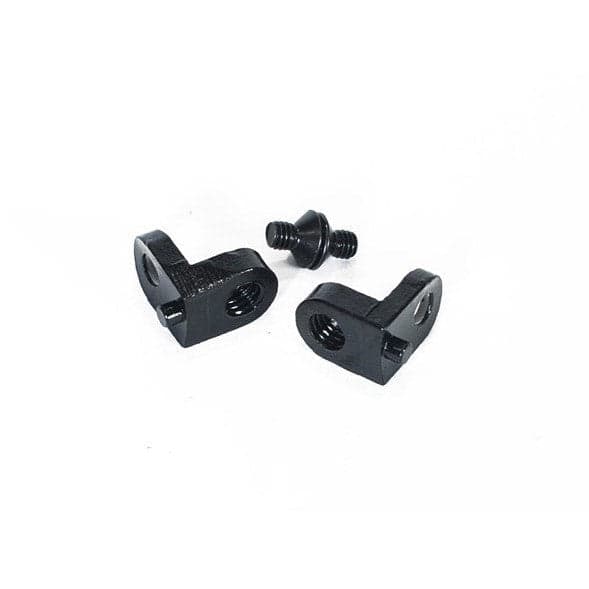
- Removable tabs. Many frames are simply drilled for bolt-on gyro tabs, which can be left off or removed to save weight and tidy the look. Aftermarket tabs are sold in pairs with small mounting screws (M4 is common), but check the thread for your frame.
- Frames without tabs. On a standard external headset, some gyro kits include a lower plate with built-in cable stops that does the same job. Integrated head tubes generally need tab holes.
- Exact position varies. Brands place and angle the tabs differently, so check the gyro and frame are compatible.
Forks do not normally have gyro tabs. Some forks have their own bosses for a front brake, which is a separate feature.
Origin
The name simply describes tabs for the gyro. Odyssey, founded in 1985, introduced its Gyro detangler in the mid 1980s, and detanglers became common on freestyle bikes later that decade. Frames added dedicated tabs as gyros spread, but which frame first had them is not documented here.
Usage examples
- "My frame has removable gyro tabs, so I took them off when I went brakeless."
- "Check for gyro tabs before you buy a detangler."
- "The barrel adjusters thread straight into the gyro tabs."
Setting up
Gyro setup is fiddly, and cable lengths and adjuster tension matter. Follow the gyro maker's instructions, and see brakes or brakeless if you are deciding whether to run one.
Related terms
- Gyro detangler: the part that uses the tabs.
- Brakes: the rear U-brake and its 990 mounts.
- Headset: the bearings the gyro sits around.
- Barspin: the trick a gyro makes possible with a brake.
Frequently asked questions about Gyro Tab
Are gyro tabs the same as brake mounts?
No. Gyro tabs hold the cable stops for a gyro detangler near the head tube. The rear U-brake bolts to separate brake bosses, called 990 mounts, on the seat stays or chainstays.
Can I run a gyro if my frame has no gyro tabs?
Sometimes. Some gyro kits include a lower plate with its own cable stops that sits on a standard external headset. Frames with integrated headsets usually need tab holes in the head tube. Check fit before buying.
Shop at LUXBMX
Popular picks for this article from LUXBMX, an Australian BMX store.
Photos: LUXBMX
BMX Wiki and LUXBMX share an owner. Links to the store are not paid placements and do not change what articles say. About this relationship
Related articles
Gyro Detangler
A gyro detangler is a rotating cable device at the headset that lets BMX handlebars spin freely without wrapping the rear brake cable around the frame.
3 min readBrakes
BMX brakes are the lever, cable and brake unit that slow the bike, with the rear U-brake being the standard on freestyle bikes.
3 min readHeadset
A BMX headset is the bearing set inside the head tube that lets the fork and handlebars turn smoothly, and most modern bikes use an integrated 45 x 45 design.
3 min readFrame Geometry
Frame geometry is the set of measurements, such as top tube length, head tube angle and chainstay length, that decides how a BMX frame fits and rides.
4 min readBarspin
A barspin is a BMX trick where the rider spins the handlebars a full 360 degrees in the air, then catches them again before landing.
3 min readBrakeless
Brakeless means riding a BMX bike with no brakes fitted, a common setup in street and park riding that frees the bars to spin without cables.
2 min read