BMX Part
Spokes
Spokes are the thin steel rods that join a BMX hub to its rim, held under tension by nipples, and their count, gauge and lacing set how strong a wheel is.
Updated 5 min read1,003 words
Spokes are the thin steel rods that connect a BMX hub to its rim. Each one is threaded into a small nut called a nipple at the rim, and the tension in all the spokes together is what makes the wheel strong. The number of spokes, their thickness (gauge) and the lacing pattern decide how tough the wheel is.
What it does
A wheel works because every spoke pulls the rim towards the hub. That tension spreads the load of a landing around the whole wheel instead of letting one spot take it. When tension is even, the wheel runs straight and true. When some spokes go loose, the rim starts to wobble and the remaining spokes take more of the load, which is when they break.
BMX wheels are small and take big hits from drops, flat landings, pegs and grinds. That is why BMX spokes are thicker and wheels carry more of them than many other bikes of a similar size.
Types and standards
Spoke count
| Count | Notes |
|---|---|
| 36 | Lighter. Standard on front wheels and many complete bikes. Strong enough for most riding. |
| 28 or 32 | Seen on lightweight race wheels. Not suited to heavy freestyle use. |
| 48 | Stronger and stiffer. Common on rear wheels for street and heavy riders. Adds some weight. |
The hub and the rim must be drilled for the same number. A 48 hole rim needs a 48 hole hub.
Gauge
Spoke thickness is often given as a wire gauge. A lower number means a thicker spoke.
| Gauge | Diameter | Notes |
|---|---|---|
| 15 | 1.8 mm | Light. Used on some race wheels, rare on freestyle wheels. |
| 14 | 2.0 mm | The common BMX size. |
| 13 | 2.3 mm | Thicker. Found on some heavy-duty and budget wheels. Needs hub holes and nipples that suit it. |
Most BMX spokes are straight gauge, meaning the same thickness along their length. Butted spokes, which are thinner in the middle and thicker at the ends, save a little weight and turn up more on race wheels.
Head shape
BMX spokes are almost always J-bend spokes. They have a bend and a flat head at the hub end that hooks through the hub flange. Straight-pull spokes, which need special hubs, are rare in BMX.
Lacing patterns
The lacing pattern describes how many other spokes each spoke crosses on its way from hub to rim.
| Pattern | Where you see it | Notes |
|---|---|---|
| 3-cross | Many 36 spoke BMX wheels | A good balance of strength and stiffness. Some builders lace 36 spoke wheels 4-cross instead. |
| 4-cross | Many 48 spoke BMX wheels | Widely seen as the strongest choice for a 48 spoke wheel. Needs longer spokes than 3-cross. |
| Radial (0-cross) | Some race front wheels | Light and neat, but not suited to every hub. Many hub makers exclude radial lacing from their warranty. |
Crossed patterns let the spokes transfer pedalling and braking force from the hub to the rim. That matters most on the rear wheel, which carries the drive from the cassette hub or freecoaster hub.
Nipples
| Nipple | Pros | Cons |
|---|---|---|
| Brass | Strong, resists rounding and corrosion. The safe default. | Heavier. |
| Aluminium alloy | Lighter, comes in colours. | Can corrode, crack or round off more easily. |
The nipple must match the spoke gauge. A 14 gauge spoke needs a 14 gauge nipple.
Sizing and compatibility
Spoke length depends on several measurements, so it has to be calculated for each wheel:
- Rim ERD. The effective rim diameter is measured where the nipples sit. Rim makers usually publish it.
- Hub flange diameter. The diameter of the circle through the spoke holes.
- Flange spacing. The distance from each flange to the hub's centre line. Rear hubs are often not symmetrical, so drive side and non-drive side spokes can need different lengths.
- Spoke count and cross pattern. A 36 spoke 3-cross wheel and a 48 spoke 4-cross wheel need different lengths even on the same rim.
Put these into a spoke length calculator, or use the hub and rim makers' figures. A spoke that is too long can poke through the nipple and puncture the tube. One that is too short leaves too little thread engaged and may pull out.
Thicker 13 gauge spokes may not fit hub flanges drilled for 14 gauge, and they need 13 gauge nipples, so check before buying. See how to build a BMX bike from parts for wheel planning.
Materials
- Stainless steel. The usual choice on quality wheels. Strong, flexible enough to cope with impacts, and resists rust.
- Plated carbon steel. Zinc-plated or galvanised steel spokes are common on cheaper bikes. They work, but rust sooner, especially near the coast where salt air gets to them.
- Black finishes. Black stainless or coated spokes are mostly about looks. The coating can wear at the crossings.
How to choose
- Match the spoke count to your hub and rim.
- Pick 36 spoke for the front wheel and most riding. Pick 48 spoke for a rear wheel that does heavy street work.
- Choose 14 gauge stainless spokes unless you have a reason not to.
- Use brass nipples for strength. Use alloy only if weight matters more to you.
- Calculate spoke length from measured or published figures.
- If you are not confident building wheels, have a wheel builder do it. A well-built wheel lasts much longer than a poorly tensioned one.
Maintenance
- Squeeze pairs of spokes each week or so. A spoke that feels much looser than its neighbours needs attention.
- Spin the wheel and watch the rim against a fixed point. A wobble means it needs truing. See how to true a wheel.
- Replace a broken spoke soon. Riding on it overloads the others and bends the rim.
- Use a spoke key that fits the nipple snugly. A loose fit rounds the flats.
- Do not over-tighten. Too much tension can crack the rim around the spoke holes.
- Check the rim tape when you change a tyre. It stops the nipple ends from cutting the tube.
- See BMX maintenance basics for a regular check routine.
Related parts
Rims, front hub, cassette hub, freecoaster hub, tyres and hub guards.
Frequently asked questions about Spokes
Should I run 36 or 48 spokes?
36 spokes is lighter and plenty for most riders, and it is the usual front wheel choice. 48 spokes is stronger and is common on rear wheels for heavy street riding. The hub and rim must have the same number of holes.
What gauge spokes do BMX wheels use?
14 gauge (2.0 mm) is the most common. Some wheels use thicker 13 gauge (2.3 mm) spokes, which need hub holes and nipples that suit them. Race wheels often use lighter 15 gauge or butted spokes.
Can I replace just one broken spoke?
Yes. Fit a spoke of the same length and gauge, bring it up to the same tension as its neighbours, then true the wheel. If several spokes break close together, the wheel may need a full rebuild.
How do I work out spoke length?
Use a spoke length calculator with the rim's effective rim diameter (ERD), the hub flange measurements, the spoke count and the cross pattern. Do not guess from another wheel, because small differences change the answer.
Watch on the LUXBMX YouTube
Videos about Spokes from the LUXBMX YouTube channel.
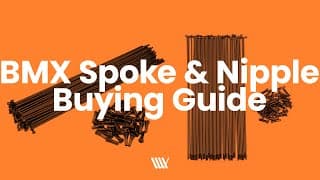

Shop at LUXBMX
Popular picks for this article from LUXBMX, an Australian BMX store.
 Colony Spokes & Nipples (20 pack)View the Colony Spokes & Nipples (20 pack) at LUXBMX
 Odyssey HGS Spokes and Nipples (40 Pack)View the Odyssey HGS Spokes and Nipples (40 Pack) at LUXBMX
Photos: LUXBMX
BMX Wiki and LUXBMX share an owner. Links to the store are not paid placements and do not change what articles say. About this relationship
Related articles
Rims
A rim is the circular aluminium hoop of a BMX wheel that holds the tyre and is laced to the hub by spokes, taking the impact of landings and grinds.
3 min readFront Hub
A front hub is the centre of a BMX front wheel, holding the axle and bearings that let the wheel spin inside the fork dropouts.
3 min readCassette Hub
A cassette hub is a BMX rear hub whose removable driver contains a ratchet freewheel, so the wheel spins freely when the rider stops pedalling.
3 min readFreecoaster Hub
A freecoaster hub is a BMX rear hub with a clutch that lets the wheel roll backwards without turning the cranks, unlike a standard cassette hub.
3 min readTyres
BMX tyres are the rubber tyres that fit 20 inch wheels, usually 2.1 to 2.5 inches wide, and are the only part of the bike that touches the ground.
3 min readHow to True a Wheel
Truing a BMX wheel means adjusting spoke tension with a spoke key, a little at a time, until the rim spins straight, round and centred in the frame or forks.
5 min read