BMX Part
Forks
A BMX fork holds the front wheel and steers the bike, with offset, steerer size and dropout width setting how it fits and handles.
Updated 3 min read674 words
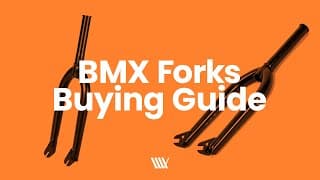
A BMX fork is the two-legged part that holds the front wheel and connects it to the frame through the head tube. The legs carry the wheel, the steerer tube rotates in the headset, and the stem clamps to the top of the steerer.
What it does
The fork steers the bike, supports the front wheel and takes the shock of landings and impacts. Its design affects how the front end feels when you turn, lean or ride a nose manual.
Offset (rake)
Offset is how far the front axle sits ahead of the steering line, measured in millimetres. It changes the trail, which is the distance between where the steering line meets the ground and the tyre contact patch.
- Lower offset (around 20 mm) gives more trail. The bike feels steadier at speed and wants to run straight.
- Higher offset (around 28 to 32 mm) gives less trail. The steering feels lighter and quicker. Many riders say it makes nose manuals feel easier and the front end more forgiving, since the wheel sits further forward.
- 25 mm is the common middle ground.
None of this is dramatic. Offset works with head tube angle, so a small change in one can be balanced by the other.
Types and standards
Leg shape
- Straight legs. Simple and light. Used on budget and older forks.
- Tapered legs. Thicker at the crown and thinner at the dropout. This keeps strength where it is needed and saves weight lower down. Most mid and high-end forks use tapered legs.
Dropouts
The dropouts are the slots at the leg ends that take the axle. Two widths are common:
| Dropout | Matching axle | Notes |
|---|---|---|
| 10 mm (3/8 inch) | 3/8 inch axle | Common on budget and older setups. Lighter. |
| 14 mm | 14 mm axle | Stronger. Common on mid and high-end builds. |
The dropout slot must match the front hub axle. Some forks come with a spacer to fit both.
Steerer tube and bearing race
The steerer is the tube at the top of the fork. The BMX standard is 1 1/8 inch (28.6 mm) and threadless, so the stem clamps on the outside. The fork needs a crown race at the base of the steerer to seat the lower headset bearing. For integrated headsets, the fork crown race seat is sized to match the headset. Your headset kit usually includes the correct race.
Materials
Chromoly is the standard. It is tough and handles impacts well. Some race forks use aluminium or carbon fibre to save weight.
Sizing and compatibility
- Steerer length. Forks ship with a long steerer. Cut it to suit your stack: head tube, headset, spacers and stem. Measure twice. Leave the steerer about 2 to 3 mm below the top of the stem so the top cap can pull down.
- Axle-to-crown height. Taller forks raise the front end and slow steering. Shorter ones do the opposite. Check the frame geometry before swapping.
- Tyre clearance. Wider tyres need enough gap between the legs. Check the fork's stated clearance.
- Brake and pegs. If you plan to ride front pegs or a front brake, check the fork has the right mounts or clearance.
How to choose
- Pick the steerer standard first: 1 1/8 inch threadless is the BMX default.
- Match the dropout width to your front hub axle, or buy both together.
- Choose offset by feel. If you do not know, 25 mm is a sound start.
- Pick tapered legs if you want a good balance of weight and strength.
- Check the crown race and headset match before you cut the steerer.
Maintenance
- Inspect the legs and dropouts for cracks, bends and worn slots, especially after hard landings.
- Keep the axle nuts tight, so the wheel cannot shift in the dropouts.
- Check the steerer and stem clamp area for cracks.
- Replace a bent fork. Straightening weakens the metal.
Related parts
- Frame geometry: head tube angle and fork offset work together.
- Headset: the fork rotates in it.
- Stem: clamps to the steerer.
- Front hub: sits in the dropouts.
- Nose manual: a trick affected by fork offset.
Frequently asked questions about Forks
What fork offset should I choose?
Around 25 mm suits most riders and is the safest default. Higher offset (28 to 32 mm) gives quicker steering and a more forward front wheel. Lower offset (about 20 mm) feels steadier at speed.
Will my front hub fit this fork?
Check the dropout slot width against the hub axle. A 10 mm (3/8 inch) slot needs a 10 mm axle. A 14 mm slot needs a 14 mm axle. The hub width must also fit between the dropouts.
Can I use any steerer length?
Steerers come long and are cut to fit. Measure carefully, because a cut cannot be undone. Most riders cut it a few millimetres below the top of the stem.
Watch on the LUXBMX YouTube
Videos about Forks from the LUXBMX YouTube channel.

Shop at LUXBMX
Popular picks for this article from LUXBMX, an Australian BMX store.
 Odyssey R32 ForksView the Odyssey R32 Forks at LUXBMX
 Odyssey R25 ForksView the Odyssey R25 Forks at LUXBMX
 Cult Sect V4 ForkView the Cult Sect V4 Fork at LUXBMX
Photos: LUXBMX
BMX Wiki and LUXBMX share an owner. Links to the store are not paid placements and do not change what articles say. About this relationship
Related articles
Frame Geometry
Frame geometry is the set of measurements, such as top tube length, head tube angle and chainstay length, that decides how a BMX frame fits and rides.
4 min readHeadset
A BMX headset is the bearing set inside the head tube that lets the fork and handlebars turn smoothly, and most modern bikes use an integrated 45 x 45 design.
3 min readStem
A BMX stem is the clamp that joins the handlebars to the fork steerer, with its reach and height setting where the bars sit.
3 min readFront Hub
A front hub is the centre of a BMX front wheel, holding the axle and bearings that let the wheel spin inside the fork dropouts.
3 min readNose Manual
A nose manual is a BMX trick where the rider balances and rolls on the front wheel only, with the rear wheel lifted off the ground.
3 min readBMX Bike Anatomy
A BMX bike is a single speed, 20 inch bike built from about 20 named parts: here is each one in order from the front wheel to the rear wheel.
3 min read